2026 Hyundai IONIQ 9
Hyundai's futuristic family hauler redefines the three-row EV.
The Hyundai IONIQ 9 arrives as an all-new model for 2026, positioned as the flagship of Hyundai's EV lineup. Available as a 4-door wagon, the IONIQ 9 slots above the IONIQ 5 in the Hyundai EV lineup. Built in Georgia, the IONIQ 9 enters the highly competitive three-row electric crossover segment, offering seating for six or seven passengers depending on configuration. Its rivals include the mechanically similar Kia EV9, Rivian R1S, and Volvo EX90.
Hyundai offers the IONIQ 9 in five trims: S, SEL, Limited, Calligraphy, and Calligraphy Design. All models share a 110-kWh battery pack, paired with either a single-motor rear-wheel-drive setup or a dual-motor all-wheel-drive system. Output ranges from 321 horsepower and 310 lb-ft of torque in the base configuration to 422 horsepower and 448 lb-ft in the top dual-motor trims. The EPA-estimated range is up to 335 miles. Thanks to its 800-volt architecture, charging from 10% to 80% can be accomplished in as little as 24 minutes on a 350-kW fast charger. Towing capacity is rated at 5,000 pounds.
Pricing starts around $58,955 and stretches to nearly $76,490 depending on trim and options. Standard features include dual 12.3-inch infotainment and instrument displays, wireless Apple CarPlay and Android Auto, and advanced driver-assist systems such as adaptive cruise control, blind-spot monitoring, and lane-keep assist. Higher trims add luxury touches like Nappa leather, a panoramic glass roof, and a configurable center console with pass-through storage. Special Calligraphy Design editions emphasize upscale materials and unique styling cues, making them the most distinctive in the lineup.
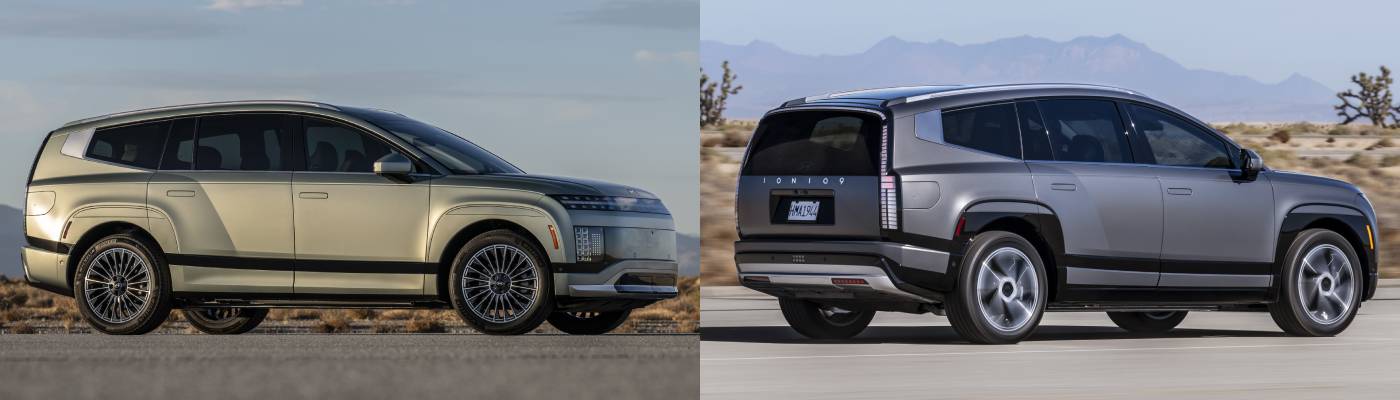
Performance in the IONIQ 9 varies depending on motor choice. The single-motor rear-drive version delivers adequate acceleration, with a 0-60 mph time of about 6.7 seconds. It feels smooth and composed, though passing power at highway speeds is modest compared to dual-motor rivals. The dual-motor AWD trims cut the sprint to roughly 5.1 seconds, offering brisk acceleration and strong midrange punch for overtaking. The instant torque delivery of the electric motors makes city driving effortless. Subjectively, the AWD version feels far more confident, especially when loaded with passengers or towing.
Fuel economy in EV terms translates to efficiency and range. The IONIQ 9's 110-kWh battery provides up to 335 miles of EPA-estimated range in rear-drive form, with AWD models slightly lower at around 310 miles. Real-world testing has shown the vehicle to average about 3 miles per kWh which translates into roughly 300 miles of driving range. It's important to note that these range estimates assume perfect driving conditions, dry road, temperate weather and flat terrain. Throw in Chicago winters, some snow and hills and overall driving range drops by 20 to 25 percent. Charging at home on a 240V outlet takes about 11.7 hours, while road trips benefit from ultra-fast charging capability. The IONIQ 9 comes standard with the NACS charging port that has become the new standard.
The all-wheel-drive system in the IONIQ 9 is electronically controlled, distributing torque instantly between front and rear axles. Driving modes include Eco, Normal, Sport, and Snow, with AWD trims offering enhanced traction in poor weather. While not a hardcore off-roader, the IONIQ 9's ground clearance and traction management allow light trail use. No dedicated off-road package is offered.
Ride quality is one of the IONIQ 9's strongest attributes. The suspension is tuned for comfort, soaking up bumps with composure while maintaining stability at highway speeds. Lower trims feel slightly firmer, while Calligraphy models deliver a more plush experience thanks to adaptive dampers. Even with large wheels, the ride remains smooth, making long trips easy on passengers.
Handling is competent but not sporty. Steering is light and somewhat vague, lacking the precision of rivals. Body lean is noticeable in corners, though not excessive, and braking performance is average, with a soft pedal feel that requires adjustment. The IONIQ 9 prioritizes comfort over sharp dynamics, which is appropriate for its mission. Because of the heavy battery pack, drivers will notice more weight transfer in quick changes of direction and perhaps a secondary motion or two while the suspension calms down.
Interior noise levels are impressively low, with minimal wind and road intrusion. Compared to the Kia EV9 and Volvo EX90, the IONIQ 9 is quieter, though the Rivian R1S edges it out with slightly better isolation. The serene cabin enhances the premium feel.
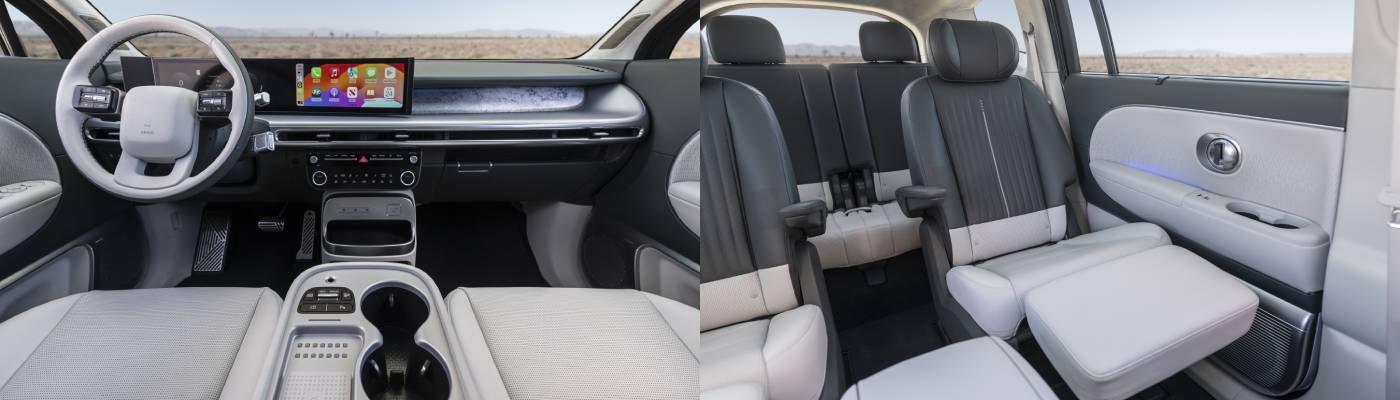
Inside, the IONIQ 9 blends futuristic design with practical touches. Sculpted surfaces, rich materials, and a minimalist dashboard create a concept-car vibe. Dual 12.3-inch screens dominate the front, while ambient lighting and a panoramic roof add flair. Materials improve with each trim, culminating in Nappa leather and wood accents in Calligraphy models.
Functionality is strong, with intuitive controls and responsive touchscreens. Physical buttons for climate and volume remain, avoiding the frustration of screen-only setups. The configurable center console and pass-through drawer highlight Hyundai's attention to family usability. Another highlight is the integrated ignition button and gear selector stalk that is mounted on the steering wheel. It is very conveniently placed and easy to use while freeing up space on the center console.
Technology and safety are comprehensive. Standard driver-assist features include adaptive cruise, blind-spot monitoring, and lane-keep assist. Higher trims add surround-view cameras, remote parking assist, and highway driving assist. The lack of true hands-free driving is a drawback compared to GM's Super Cruise or Ford's BlueCruise. In addition, Hyundai's lane assistance can grow annoying with its propensity to tug at the steering wheel.
Seating is spacious, with six- or seven-passenger layouts. The first two rows offer generous legroom and comfort, while the third row is adult-friendly, a rarity in the segment. Access to the third row is straightforward thanks to sliding second-row seats, and ingress/egress is easy due to wide door openings.
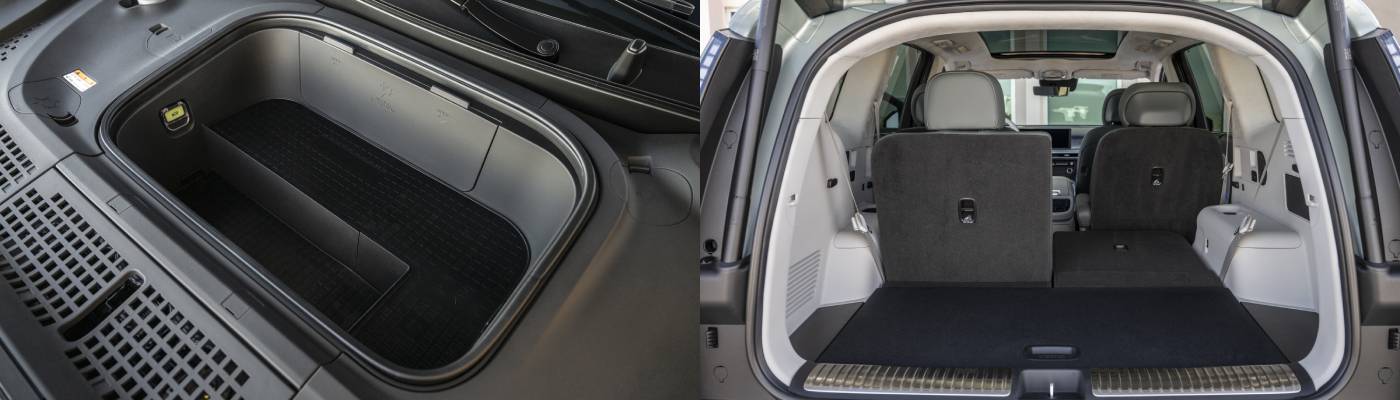
Cargo capacity is generous, with about 20 cubic feet behind the third row, expanding to 57 cubic feet with the second row folded, and over 90 cubic feet with all seats down. There is also a small front trunk (frunk) that's perfect for storing the travel EV charging cable and various charging adaptors. Interior storage is abundant, with multiple cubbies, USB-C ports in all three rows, and available 110V AC outlets for powering devices.
Bottom Line -- The IONIQ 9's strengths lie in its spacious interior, refined ride, long range, and family-friendly features. Weaknesses include vague steering, average braking, and infotainment that feels dated. Unique highlights include its futuristic design, ultra-fast charging, and upscale Calligraphy Design trim. Against rivals, it offers excellent value, though the Rivian R1S is more engaging to drive. The SEL trim strikes the best balance of price and features, offering AWD, strong range, and key amenities without reaching the top-tier price.