2026 Kia Sportage
Style, space, and electrified options, Sportage hits the trifecta run in the compact crossover class.
Offering gas-only, hybrid and plug-in hybrid powertrains, the Kia Sportage returns for 2026 with a mild refresh that includes an updated front clip, larger digital displays and additional driver-assist features. The Sportage remains a two-row, five-passenger compact crossover offered only as a 4-door wagon. Competitors include Ford Escape, Honda CR-V, Hyundai Tucson, Mazda CX-5, Nissan Rogue, Subaru Forester, Toyota RAV4, and Volkswagen Tiguan.
Kia offers the 2026 Sportage in a wide range of trims-LX, EX, SX, SX Prestige, X-Line, and X-Pro Prestige. Gas-only models get a 2.5-liter naturally aspirated 4-cylinder engine producing 187 horsepower and 178 lb-ft of torque, paired with an 8-speed automatic transmission and either front- or all-wheel drive. The Sportage Hybrid (HEV) and Plug-In Hybrid (PHEV) use a 1.6-liter turbocharged 4-cylinder paired with electric motors. The hybrid system produces 227 horsepower (combined), while the Plug-In Hybrid delivers 268 horsepower (combined). Both route power through a 6-speed automatic transmission and come standard with AWD. The PHEV includes a 13.8-kWh battery enabling an EPA-estimated 33-34 miles of all-electric range depending on trim. Towing capacity varies by powertrain: the gas model can tow up to 3,500 pounds, while the PHEV is rated at 2,000 pounds.
Pricing for the 2026 Sportage lineup spans from the low $30,000s for the gas LX to the low-to-mid $50,000s for the Sportage Plug-In Hybrid X-Line Prestige. Standard features include a large touchscreen, wireless smartphone integration, advanced driver-assistance tech, and generous interior space. Optional equipment ranges from a panoramic sunroof to a surround-view camera system, upgraded audio, and quilted SynTex upholstery. The PHEV trims add premium features such as a head-up display, smart power liftgate, and enhanced safety tech.
ENGINE PERFORMANCE
The base 2.5-liter engine in the standard Sportage is tuned for efficiency rather than outright speed. With 187 horsepower and 178 lb-ft of torque, acceleration is adequate for daily commuting, though not particularly urgent when merging onto fast highways. Expect a 0-60 mph time in the mid-8-second range, consistent with other naturally aspirated engines in the segment. The 8-speed automatic transmission shifts unobtrusively, though it occasionally hunts for gears under heavy throttle, a trait common in efficiency-oriented crossovers. Passing power is acceptable but requires planning, especially when the vehicle is loaded with passengers or cargo.
The Sportage Hybrid improves responsiveness significantly thanks to its turbocharged 1.6-liter engine and electric motor assistance. With a combined output of 227 horsepower, the hybrid feels livelier off the line and more confident in mid-range acceleration. The electric motor fills in torque gaps, making the hybrid feel more refined and more capable during highway passing. Its 0-60 mph time typically falls in the low-7-second range, giving it a noticeable advantage over the gas model.
The Sportage Plug-In Hybrid is the performance leader of the lineup. Its 268-horsepower combined output and 271 lb-ft of torque deliver strong, immediate thrust, though in EV only operation acceleration is somewhat blunted. The 6-speed automatic is smoother here than in the hybrid, thanks to the PHEV's stronger electric assistance. Expect a 0-60 mph time in the mid-6-second range, making it one of the quicker compact crossovers in its class. The PHEV's electric-only operation is quiet, responsive, and ideal for urban driving.
FUEL ECONOMY
The standard 2.5-liter Sportage returns EPA ratings of 25/33/28 mpg (city/highway/combined) in FWD form and 24/30/26 mpg with AWD. With a 14.3-gallon fuel tank, highway range can exceed 470 miles in optimal conditions. Real-world results tend to align closely with EPA estimates, though AWD models may dip slightly below their ratings in cold weather or heavy traffic.
The Sportage Hybrid improves efficiency significantly, with EPA numbers typically in the high-30s combined depending on configuration. Its slightly smaller fuel tank still allows for competitive highway range of about 440 miles thanks to its efficiency advantage. Real-world hybrid owners often report mid-to-upper-30s mpg in mixed driving.
The Sportage Plug-In Hybrid offers 33-34 miles of electric-only range and an EPA combined rating of 36 mpg once the battery is depleted. Real-world EV range varies with temperature and driving style but generally stays close to EPA estimates. Charging on a 240-volt Level 2 system takes about two hours.
ALL-WHEEL DRIVE SYSTEM & DRIVING MODES
Kia's AWD system in the Sportage lineup is designed primarily for traction and stability rather than hardcore off-roading. It uses an electronically controlled coupling to distribute torque between the front and rear axles as needed. The PHEV includes Terrain Mode with Snow, Sand, and Mud settings, enhancing traction on loose surfaces. The X-Line and X-Pro Prestige trims add increased ground clearance, all-terrain tires, and descent control, making them more capable on rough trails, though still short of true off-road specialists.
RIDE QUALITY
Ride comfort is one of the Sportage's strongest attributes. The suspension tuning prioritizes compliance, absorbing bumps and road imperfections with a level of refinement that rivals some near-luxury competitors. The standard models feel soft but controlled, maintaining composure over broken pavement without excessive body motion. The X-Pro Prestige, with its all-terrain tires, introduces slightly more road texture and softness, but the trade-off is improved rough-surface capability.
The hybrids and PHEV feel marginally heavier due to their battery packs, but Kia has tuned the suspension to compensate, resulting in a planted, stable ride. The added weight even helps dampen sharp impacts, giving the electrified models a more premium feel in some situations.
HANDLING CHARACTERISTICS
The Sportage's handling is competent and predictable rather than sporty. Steering feel is light and somewhat numb on center, but accuracy is good, making the vehicle easy to place in tight urban environments. Body roll is noticeable in aggressive cornering but well-managed for a family-oriented crossover. Braking performance is consistent in the gas model, while the hybrid and PHEV introduce the typical regenerative-braking softness at the top of the pedal. Kia has done a commendable job blending regen and friction braking, but keen drivers will still notice the transition.
INTERIOR NOISE LEVELS
The cabin of the 2026 Sportage is impressively quiet for the segment. Wind noise is well-suppressed thanks to careful aerodynamic shaping, and road noise is moderate even on coarse pavement. The PHEV is the quietest of the lineup in EV mode, offering near-silent operation at low speeds. The gas engine can be coarse sounding in hard acceleration, while the turbo engine in the HEV and PHEV is smoother it can still groan a bit at full tilt. Compared with rivals like the CR-V and RAV4, the Sportage is competitive-quieter than the RAV4 but slightly louder than the exceptionally hushed CR-V at highway speeds.
INTERIOR DESIGN, MATERIALS & FEATURES
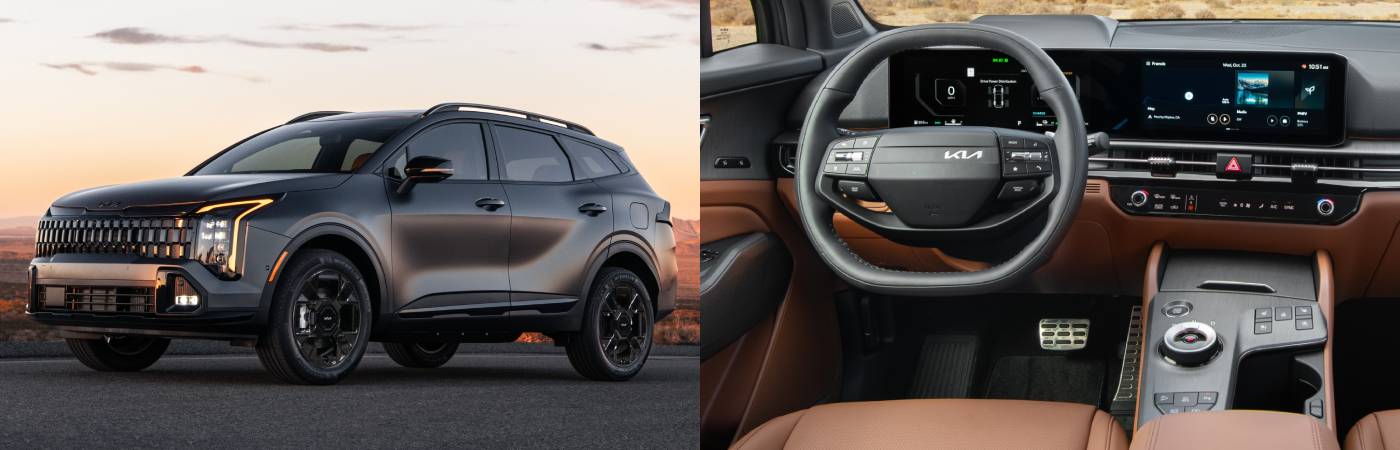
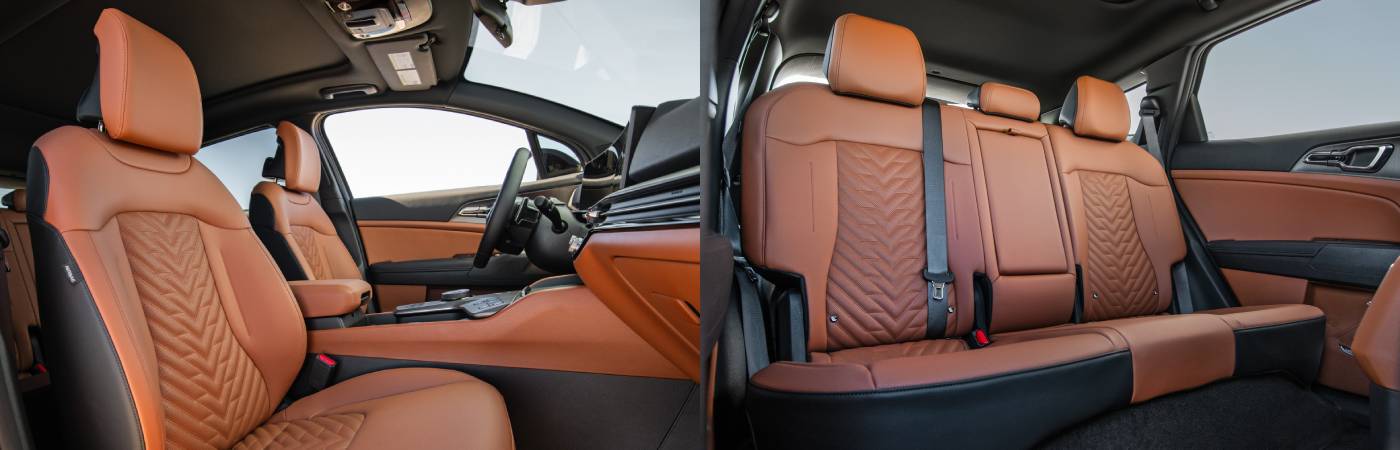
Kia continues to excel in interior design, and the 2026 Sportage is no exception. The cabin features a modern, horizontal layout anchored by a large digital display panel that blends the instrument cluster and infotainment screen. Materials are high-quality for the class, with soft-touch surfaces, available quilted SynTex upholstery, and tasteful metallic accents. Higher trims feel genuinely upscale, rivaling some entry-luxury models. The panoramic sunroof, ambient lighting, and high-resolution screens contribute to a premium atmosphere.
INTERIOR FUNCTIONALITY
Functionality is another strong point. Kia's infotainment interface is intuitive, with responsive touch controls and clear graphics. The updated and enlarged displays for 2026 are a plus. And the available head-up display is a nice touch in this class. Physical knobs for climate and volume remain, somewhat avoiding the frustration of touchscreen-only systems. However, Kia has found a way to frustrate, adding a toggle between audio and climate control for the same switchgear. It can grow maddening at times. Wireless Apple CarPlay and Android Auto are standard on most trims.
TECHNOLOGY & SAFETY FEATURES
The 2026 Sportage lineup includes a comprehensive suite of safety and driver-assistance technologies. Standard features include forward collision-avoidance assist with pedestrian and cyclist detection, lane-keeping assist, lane-following assist, blind-spot monitoring, rear cross-traffic avoidance, and smart cruise control. Higher trims add a surround-view monitor, blind-spot view camera, parking collision-avoidance assist, and Highway Driving Assist. The PHEV trims include the most advanced tech packages as standard.
SEATING & COMFORT
The Sportage offers seating for five, with no third-row option. Front seats are supportive and available with heating, ventilation, and power adjustments. Rear-seat space is among the best in the segment, with over 41 inches of legroom-more than many midsize crossovers. Entry and exit are easy thanks to wide door openings and a slightly elevated seating position. The rear bench reclines for added comfort, making long trips more pleasant for passengers.
CARGO CAPACITY & STORAGE
Cargo capacity is a standout feature. The gas Sportage offers 39.6 cubic feet behind the second row and 74.1 cubic feet with the seats folded. The dual-level cargo floor provides additional flexibility. The PHEV, due to its battery placement, offers slightly less space at 34.5 cubic feet behind the second row and 65.5 cubic feet with seats folded. USB ports are plentiful in both rows, and higher trims include a household-style AC outlet for powering small devices.
BOTTOM LINE
The 2026 Kia Sportage lineup stands out for its design, interior space, technology, and breadth of powertrain options. The gas model is competent and affordable, the hybrid strikes an excellent balance of performance and efficiency, and the PHEV offers strong acceleration and meaningful electric range. Weaknesses include modest acceleration in the base engine and slightly numb steering, but these are common trade-offs in the segment. The Sportage's interior quality and cargo space give it a competitive edge over many rivals.
Against the CR-V, RAV4, and mechanically similar Tucson, the Sportage holds its own with superior styling, more interior room, and a richer feature set at similar price points. The best value in the lineup is the Sportage Hybrid EX, which combines strong efficiency, improved performance, and a robust list of standard features without reaching the higher price of the PHEV.