2026 Kia EV9
Kia proves that a family-sized SUV can be practical, desirable AND electric.
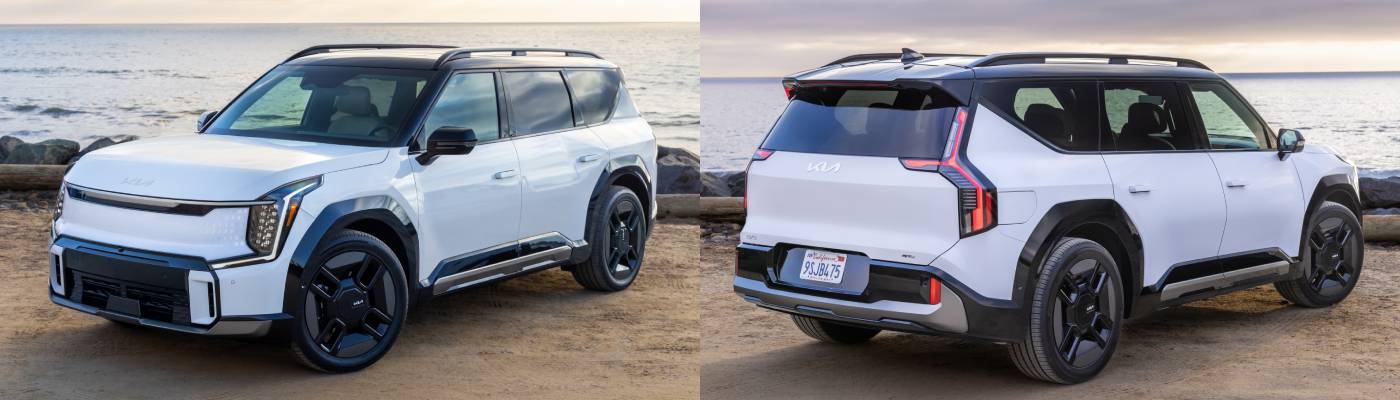
The 2026 Kia EV9 enters its second model year in the United States as one of the most ambitious electric SUVs on the market, and one of the few that has the potential to genuinely reshape expectations for a mainstream three-row EV. Kia's history with large SUVs in America has been defined by the Telluride, a vehicle that became a runaway success by blending value, design, and capability. The EV9 follows that same formula but applies it to a dedicated electric platform, the E-GMP architecture shared with the Hyundai Ioniq 5, Ioniq 6, and Kia EV6. For 2026, the EV9 receives software refinements, improved charging logic, and expanded availability of the long-range battery on lower trims. It competes in the emerging three-row EV segment against the Cadillac Vistiq, Mercedes-Benz EQS SUV, Rivian R1S, Tesla Model X, and Volvo EX90. Seating configurations include six- and seven-passenger layouts, and the EV9 is offered exclusively as a 4-door wagon.
Kia offers the EV9 in several trims, each with distinct powertrain configurations. The Light model uses a single rear motor producing 215 horsepower and 258 pound-feet of torque, paired with the standard 76.1-kWh battery. The Light Long Range increases battery capacity to 99.8 kWh and uses a more efficient 201-horsepower rear motor tuned for maximum range rather than acceleration. The Wind and Land trims introduce dual-motor all-wheel drive with a combined 379 horsepower and 443 pound-feet of torque, while the GT-Line uses the same motors but increases torque output to 516 pound-feet for stronger off-the-line response. All EV9 models use a single-speed reduction-gear transmission typical of modern EVs. Towing capacity is rated at up to 5,000 pounds on dual-motor versions when properly equipped. Because the EV9 is a fully electric vehicle, there are no hybrid or plug-in hybrid variants. Instead, the lineup revolves around the two battery sizes, the choice of rear- or all-wheel drive, and the performance tuning of the motors.
Pricing for the 2026 EV9 begins in the mid-$50,000 range for the Light model and climbs into the mid-$70,000s for the GT-Line. Standard features include a dual-screen panoramic display, wireless Apple CarPlay and Android Auto, heated front seats, a full suite of advanced driver-assistance systems, and over-the-air update capability. Higher trims add amenities such as ventilated seats, a head-up display, a premium Meridian audio system, a digital rearview mirror, and second-row captain's chairs with power-reclining ottomans. Safety technology includes forward collision avoidance, blind-spot monitoring, rear cross-traffic alert, lane-centering assist, adaptive cruise control, and Highway Driving Assist 2 with lane-change capability. Special editions include the GT-Line, which adds unique exterior styling, upgraded performance tuning, and exclusive interior materials. The EV9's options list is relatively short, as Kia packages most features into trim levels rather than standalone extras.
PERFORMANCE
The EV9's performance varies significantly depending on the chosen powertrain. The base Light model with the standard battery offers adequate acceleration for daily driving, with a 0-60 mph time in the mid-eight-second range. It feels smooth and predictable, with enough passing power for city driving, though it is not designed for spirited driving and highway passing punch leaves something to be desired. The Light Long Range sacrifices some acceleration for efficiency, stretching the 0-60 mph time to around nine seconds, but its relaxed demeanor suits drivers who prioritize range above all else. The dual-motor Wind and Land trims transform the EV9 into a far more confident performer, cutting the 0-60 mph time to roughly five seconds and delivering strong midrange thrust for merging or overtaking. The GT-Line sharpens responses further, with its 516 pound-feet of torque providing a muscular, immediate surge that makes the large SUV feel surprisingly quick. Across all versions, the single-speed transmission delivers seamless power without hesitation, and the EV9's regenerative braking system is well-calibrated, offering multiple levels including a true one-pedal driving mode.
EFFICIENCY & RANGE
Because the EV9 is fully electric, fuel efficiency is measured in MPGe rather than traditional gasoline metrics. The Light model with the standard battery is rated at approximately 88 MPGe combined, while the Light Long Range improves efficiency slightly thanks to its lower-output motor. Dual-motor versions fall into the mid-70s MPGe combined due to the added weight and power. Driving range varies widely: the standard-battery Light offers around 230 miles, the Light Long Range stretches to roughly 300 miles, and the dual-motor Wind and Land trims deliver around 280 miles. The GT-Line's performance tuning reduces range slightly to the mid-260s. Real-world efficiency tends to track closely with EPA estimates, though cold weather and high-speed driving can reduce range more noticeably than in gasoline vehicles. The EV9's battery pack supports 800-volt fast charging, allowing the vehicle to add roughly 150 miles of range in about 15 minutes under ideal conditions. Because it is electric, there is no fuel tank or gasoline range to report.
ALL-WHEEL DRIVE
Like most EVs, there's no direct connection between the front and rear axles. All-wheel drive on the EV9 is provided by the dual-motor setup, which continuously varies torque distribution between the front and rear motors based on traction demands. The system reacts quickly and smoothly, giving the EV9 a planted feel on slippery surfaces. Drive modes include Eco, Normal, Sport, and Snow, each adjusting throttle response, steering weight, and torque distribution. Off-road capability is modest but respectable for a family EV, with the EV9 offering hill-descent control, a dedicated terrain mode, and sufficient ground clearance for light trails. The GT-Line adds a slightly more aggressive traction calibration, though the EV9 is not intended as a rock-crawler.
RIDE QUALITY & ROADHOLDING
Ride quality is one of the EV9's strongest attributes. The suspension strikes a careful balance between firmness and compliance, absorbing bumps with a controlled, well-damped motion that avoids the floatiness sometimes found in large SUVs. Lower trims ride slightly softer due to smaller wheels and taller tire sidewalls, while the GT-Line's larger wheels introduce a bit more road feel without becoming harsh. Over broken pavement, the EV9 maintains composure, and the long wheelbase contributes to a stable, confident ride at highway speeds. Even with its boxy shape, the EV9 feels refined and settled, with minimal vertical motion over undulating roads.
Handling is better than expected for a vehicle of this size. The steering is light at low speeds and gains appropriate weight as speed increases, though it is not particularly communicative. Body roll is present but well-controlled, and the EV9 corners with a sense of predictability that inspires confidence. Braking performance is strong, with a firm pedal feel and smooth transitions between regenerative and friction braking. The GT-Line's sportier tuning sharpens responses slightly, but all versions of the EV9 prioritize stability and comfort over outright athleticism.
INTERIOR NOISE
Interior noise levels are impressively low. The EV9's cabin benefits from extensive sound insulation, laminated glass, and the inherent quietness of an electric powertrain. Wind noise is minimal despite the SUV's upright profile, and road noise is well-suppressed even on coarse pavement. Compared to direct competitors, the EV9 is quieter than the Tesla Model X and Rivian R1S, roughly on par with the Volvo EX90, and slightly behind the Mercedes-Benz EQS SUV, which remains the benchmark for whisper-quiet operation.
INTERIOR DESIGN
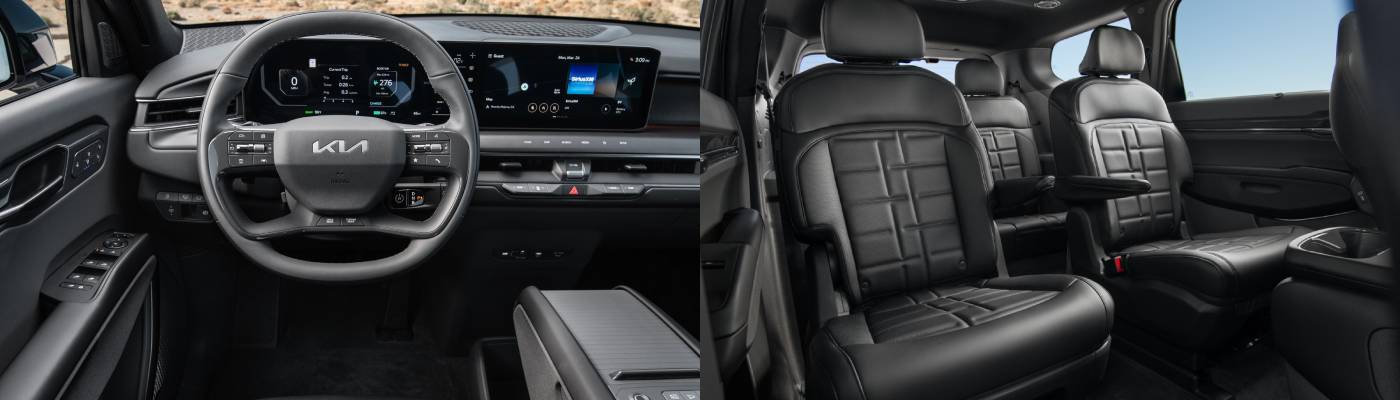
The interior design of the EV9 blends modern minimalism with practical functionality. The dashboard features a wide, horizontal layout anchored by dual 12.3-inch displays and a smaller climate-control screen integrated between them. Materials vary by trim, with higher models offering soft-touch surfaces, ambient lighting, and premium upholstery. The cabin feels airy and open thanks to large windows and a flat floor, and the overall aesthetic leans toward Scandinavian simplicity with a Asian flair. Fit and finish are solid, and the EV9's interior feels appropriately upscale for its price point.
Functionality is another strong suit. Controls are generally intuitive, with a mix of physical buttons and touch-sensitive panels. The climate controls are always accessible thanks to the dedicated HVAC display screen, and the infotainment system responds quickly to inputs. One minor gripe is that the HVAC controls are somewhat hidden from view behind the steering wheel. Storage solutions are abundant, including a large center console, deep door pockets, and multiple cubbies for small items. The EV9's flat floor and wide door openings make it easy to move around the cabin, and the second-row seats slide and recline to optimize comfort or cargo space.
TECHNOLOGY & SAFETY FEATURES
Technology and safety features are comprehensive. The EV9 includes Kia's latest infotainment software with over-the-air update capability, wireless smartphone integration, and available augmented-reality navigation. Safety systems include forward collision avoidance, pedestrian and cyclist detection, blind-spot monitoring, rear cross-traffic alert, lane-centering assist, adaptive cruise control, and Highway Driving Assist 2, which can perform automated lane changes on the highway. The EV9 also offers a surround-view camera system, remote smart parking, and a digital key that allows smartphone-based vehicle access.
SEATING & COMFORT
Seating comfort is excellent across all three rows. The front seats offer generous cushioning, heating, ventilation, and available massage functions. However, some might take exception to the front-seat headrests that are positioned further forward than you might expect. The second row can be configured with either a bench or captain's chairs, the latter offering power-reclining ottomans on higher trims. Legroom is abundant, and headroom remains generous thanks to the EV9's tall roofline. Access to the third row is straightforward, with wide door openings and a sliding second row that creates a usable pathway. The third row itself is more spacious than most competitors, accommodating adults for shorter trips and children comfortably for longer journeys.
CARGO CAPACITY
Cargo capacity is one of the EV9's practical strengths. Behind the third row, the EV9 offers roughly 20 cubic feet of space, expanding to around 43 cubic feet with the third row folded. With both rear rows folded flat, total cargo volume approaches 82 cubic feet. The load floor is low and wide, making it easy to load bulky items. Interior storage includes a large center console, multiple cupholders, and hidden compartments. USB-C ports are available in all three rows, and higher trims include a 110-volt AC power outlet for charging laptops or powering small appliances.
BOTTOM LINE
In summary, the 2026 Kia EV9 stands out as one of the most well-rounded electric SUVs available today. Its strengths include a spacious and flexible interior, refined ride quality, strong dual-motor performance, competitive driving range, and a long list of standard technology and safety features. Weaknesses are relatively minor and include slower acceleration on the base models and slightly reduced range on the GT-Line. Unique features such as second-row reclining ottomans, 800-volt fast charging, and a true three-row layout set the EV9 apart from many competitors. Against rivals, the EV9 offers a compelling blend of performance, practicality, and value, often undercutting luxury-branded EVs while matching or exceeding them in usability. The best trim for most buyers is the Wind AWD, which balances range, performance, features, and price more effectively than the base or GT-Line models.