2026 Ford Explorer
A tech-savvy, power-packed family crossover that refuses to blend in.
The 2026 Ford Explorer enters the U.S. market as the latest evolution of one of America's longest-running and best-known three-row crossover, a nameplate that helped define the modern family utility segment when it debuted in the early 1990s. For 2026, Ford continues refining the Explorer after its recent 2025 redesign, adding updated technology, expanded driver-assistance features, and new trim variations, including the rugged Tremor and the performance-oriented ST. The Explorer remains a midsize, three-row , 4-door wagon with seating for six or seven depending on whether buyers choose captain's chairs or a bench in the second row. It competes in one of the most crowded segments in the industry, going head-to-head with rivals such as the Chevrolet Traverse, Dodge Durango, Honda Pilot, Hyundai Santa Fe, Kia Telluride, Mazda CX-90, Subaru Ascent, Toyota Highlander, and Volkswagen Atlas.
Ford offers the 2026 Explorer in six trims: Active 100A, Active, ST-Line, Tremor, ST, and Platinum. Powertrain choices include a standard 2.3-liter turbocharged four-cylinder producing 300 horsepower and 311 lb-ft of torque, and a 3.0-liter twin-turbo V6 generating 400 horsepower and 415 lb-ft of torque. Both engines pair with a conventional 10-speed automatic transmission. Rear-wheel drive is standard on most trims, while all-wheel drive is optional across the lineup and standard on the Tremor. Towing capacity when with properly equipped is 5,600 pounds.
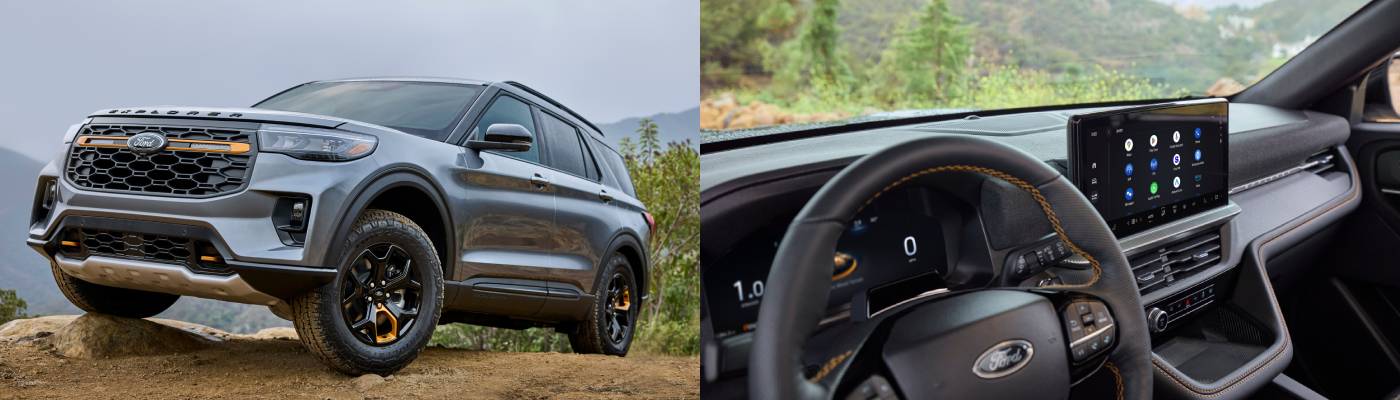
Pricing for the 2026 Explorer starts around the upper-$30,000 range and climbs into the upper-$50,000s depending on trim and options. Standard features include a 13.2-inch touchscreen with Google Built-In, wireless Apple CarPlay and Android Auto, Ford Co-Pilot360 Assist+, LED lighting, and a digital instrument cluster. Higher trims add amenities such as massaging seats, upgraded audio, adaptive headlamps, and BlueCruise hands-free driving capability. Special editions include the off-road-focused Tremor and the high-performance ST, each offering unique styling and hardware upgrades.
ENGINE PERFORMANCE
Ford's 2.3-liter EcoBoost four-cylinder remains the Explorer's workhorse engine, delivering 300 horsepower and 311 lb-ft of torque. In real-world driving, this engine provides brisk acceleration for a vehicle of this size, with 0-60 mph times landing around six seconds, a figure that places it among the quicker base engines in the segment. The turbocharged torque curve gives the Explorer strong mid-range passing power, making highway merges and two-lane overtakes feel confident rather than strained. The 10-speed automatic transmission pairs well with this engine, shifting smoothly and keeping the four-cylinder in its power band without excessive hunting.
The 3.0-liter twin-turbo V6 transforms the Explorer into one of the most powerful mainstream midsize crossovers on the market. With 400 horsepower and 415 lb-ft of torque, this engine delivers genuinely quick acceleration, hitting 60 mph in about 5.1 seconds. The V6's broad torque band gives the Explorer effortless passing power, and the 10-speed automatic feels more decisive when paired with this engine, delivering quicker downshifts and more authoritative responses to throttle inputs. In addition, the V6 is smoother and more refined than the four-cylinder.
FUEL ECONOMY
EPA fuel-economy ratings for the 2026 Explorer vary by engine and drivetrain. The 2.3-liter EcoBoost four-cylinder typically returns mid-20s mpg combined in rear-wheel-drive form and slightly lower numbers with all-wheel drive. The 3.0-liter twin-turbo V6, while significantly more powerful, trades some efficiency for performance and generally lands in the high-teens to low-20s combined depending on configuration. Both engines run on regular unleaded fuel, though Ford recommends premium for the V6 to achieve maximum performance. Fuel-tank capacity remains similar to prior years with the V6 getting a slightly larger tank, allowing highway ranges that comfortably exceed 400. Real-world fuel economy tends to track a few mpg below EPA estimates, especially in city driving or when using the V6's abundant power frequently.
ALL-WHEEL-DRIVE SYSTEMS & DRIVING MODES
The Explorer's available all-wheel-drive system is rear-biased, a layout that enhances handling balance and traction under acceleration. Most trims offer AWD as an option, while the Tremor includes it as standard equipment. Ford's Terrain Management System provides selectable drive modes tailored to conditions such as snow, sand, mud, and towing, adjusting throttle response, transmission mapping, and traction-control behavior. The Tremor trim adds off-road-focused hardware including a lifted suspension, all-terrain tires, and a Torsen limited-slip rear axle, giving it meaningful capability for light to moderate trail use.
RIDE QUALITY
Ride quality in the 2026 Explorer varies meaningfully by trim. Models equipped with the 2.3-liter engine and standard suspension tuning deliver a comfortable, well-controlled ride that absorbs most bumps without harshness. The rear-wheel-drive platform contributes to a planted feel on the highway, and the suspension strikes a reasonable balance between firmness and compliance. In subjective impressions, the Explorer feels more composed than some rivals over broken pavement, though not quite as plush as the segment's softest-riding entries.
The ST and Tremor trims introduce firmer suspension setups. The ST's sport-tuned suspension enhances handling but transmits more road texture into the cabin, making it feel more athletic but slightly less cushioned. The Tremor's lifted suspension and all-terrain tires add a degree of softness over large impacts but can introduce additional tire noise and minor body motion on uneven pavement. Overall, the Explorer's ride remains solidly competitive, with each trim offering a distinct personality.
HANDLING & ROADHOLDING
The Explorer's steering is over boosted with a numb feeling. At least its accurate and tracks true on the highway. Body lean is well-controlled for a three-row crossover, especially in models equipped with the sport-tuned suspension. The rear-drive architecture helps the Explorer feel more balanced in corners than some front-drive-based competitors, and the 10-speed automatic contributes to smooth, predictable responses during spirited driving. Braking performance is strong, with a firm pedal feel and good modulation, though the heavier V6 models can exhibit slightly longer stopping distances under repeated hard braking.
INTERIOR NOISE
Interior noise levels in the 2026 Explorer are competitive for the segment. Wind noise is well-managed thanks to aerodynamic refinements, and the cabin remains quiet at highway speeds. The four-cylinder engine is slightly gruff in hard acceleration, while the V6 produces a pleasant growl under at all times. Compared with direct competitors, the Explorer falls in the middle of the pack. It's quieter than some value-oriented rivals but not as hushed as the most premium entries in the class.
INTERIOR DESIGN, MATERIALS & FEATURES
The 2026 Explorer's interior reflects Ford's recent push toward more modern, tech-forward cabins. The 13.2-inch touchscreen dominates the dashboard, integrating Google Built-In for navigation and voice control. Materials vary by trim, with the Platinum offering the most upscale environment, including massaging seats and upgraded leather. Lower trims use durable plastics and cloth or vinyl upholstery, but the layout remains clean and functional. The digital instrument cluster adds a premium touch, and the overall design feels contemporary without being overly futuristic.
INTERIOR FUNCTIONALITY
Functionality remains one of the Explorer's strengths. Controls are logically arranged, and the large touchscreen is responsive and easy to navigate. Physical buttons for climate control help reduce distraction, and storage solutions throughout the cabin. This includes a sizable center console, lots of cubbies, and multiple door pockets. The driving position is commanding, visibility is good, and the cabin layout supports both daily commuting and long-distance travel.
TECHNOLOGY & SAFETY FEATURES
Technology is a major highlight for 2026. Ford Co-Pilot360 Assist+ is standard across the lineup, bringing features such as forward collision warning with automatic braking, adaptive cruise control, lane centering, blind-spot monitoring, rear cross-traffic alert, evasive steering assist, and intersection collision mitigation. Higher trims offer BlueCruise hands-free highway driving capability, upgraded audio systems, and advanced lighting technology. The Explorer's tech suite positions it as one of the more advanced vehicles in the segment.
PASSENGER SEATING & COMFORT
The Explorer offers seating for six or seven depending on configuration. Front-row seats are supportive and spacious, with available heating, ventilation, and massage functions on higher trims. The second row provides generous legroom, especially with captain's chairs, and access to the third row is reasonably easy thanks to a sliding mechanism. The third row is best suited for children or shorter adults, though it remains usable for occasional adult transport. Entry and exit are straightforward thanks to wide door openings and a comfortable step-in height.
CARGO CAPACITY & STORAGE
Cargo capacity remains one of the Explorer's strong suits. All seats in play, Explorer offers 16.3 cubic feet of space. Folding the third row opens up 46 cubic feet of cargo space. All seats down and there's a generous 85 cubic feet of capacity. Folding the seats creates a flat, expansive load floor. The tailgate opening is traditional, providing a wide and relatively low liftover. Interior storage is plentiful, with multiple USB ports and available AC power outlets for charging devices or powering small electronics.
BOTTOM LINE
The 2026 Ford Explorer stands out as one of the most versatile and well-rounded midsize crossovers on the market. Its broad range of trims allows buyers to tailor the vehicle to their needs, whether they prioritize comfort, performance, off-road capability, or value. The standard 2.3-liter engine delivers strong everyday performance, while the 3.0-liter V6 elevates the Explorer into a different league entirely. Technology is a major selling point, with Ford Co-Pilot360 Assist+ and the large 13.2-inch touchscreen giving the Explorer a modern, premium feel. The interior is spacious, functional, and family-friendly, and the rear-drive platform contributes to confident handling and a composed ride.
Weaknesses include fuel economy that trails some competitors and interior materials on lower trims that don't quite match the segment's best. Still, the Explorer's combination of performance, technology, towing capability, and trim diversity makes it a compelling choice. Among the lineup, the ST-Line trim offers the best balance of features and value, adding sporty styling and upgraded amenities without the higher cost of the ST or Platinum. For buyers seeking maximum performance, the ST remains one of the most exciting three-row SUVs available.